
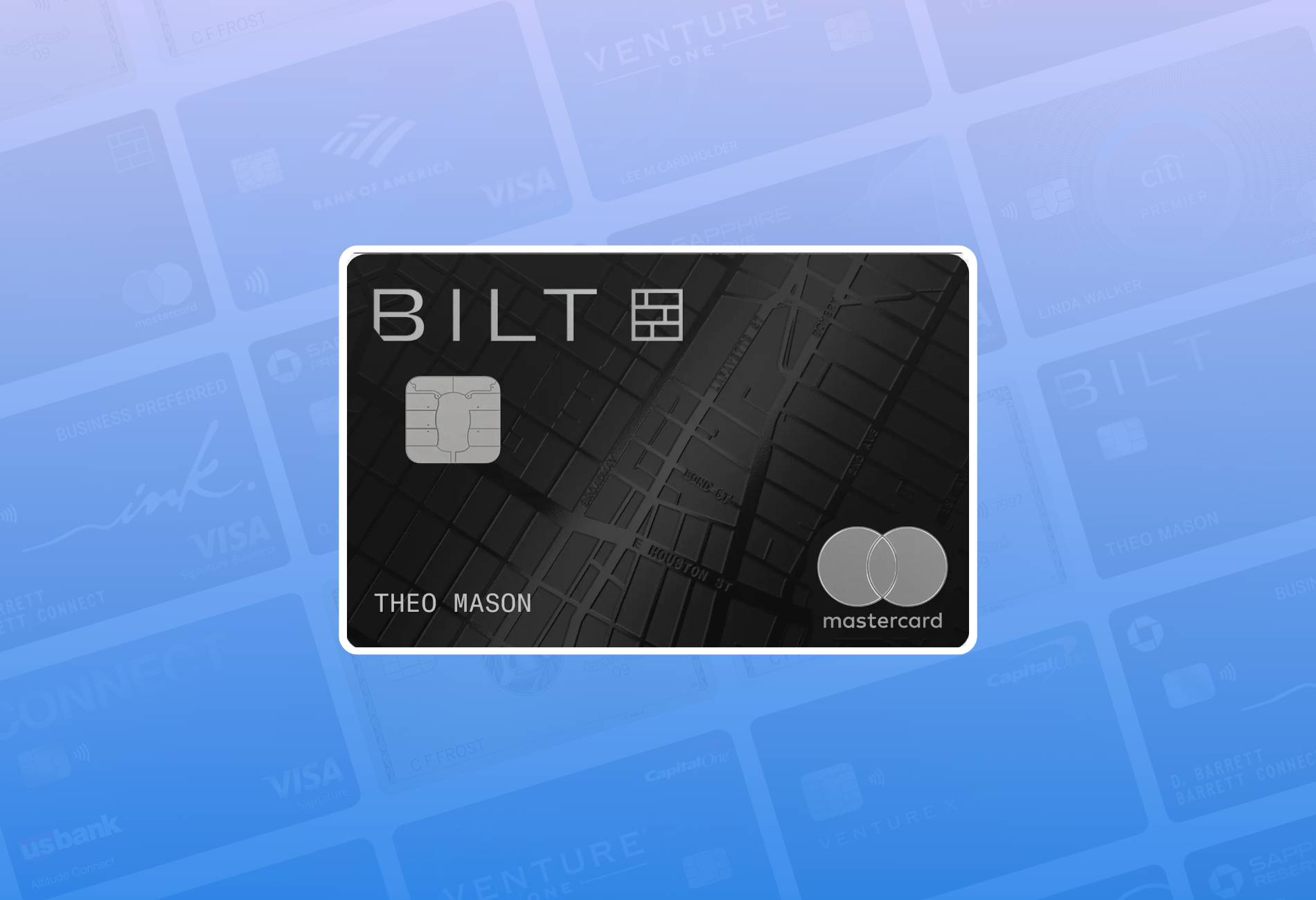
At a glance
- Best for: Bilt card for dining or grocery maximizers
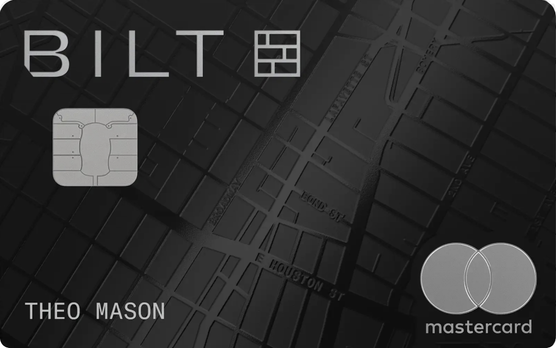
- Annual Fee: $95
- APR: 10% intro APR on new eligible purchases for 12 billing cycles after account opening. After the intro period, a variable APR of 26.74% – 34.74% will apply.
- Reward Rate: 1-3X
- Recommended Credit: 670-850
Bilt Obsidian Card
$200 of Bilt Cash
Offer Details:
Get $200 of Bilt Cash when you apply and get approved. Terms apply
Why we like it
This card delivers standout value where it counts. Cardholders can make housing payments with no transaction fees, helping maximize rewards on one of life’s biggest expenses. It also offers a $100 Bilt Travel Hotel credit each year, applied as two $50 statement credits for qualifying hotel bookings through the Bilt Travel Portal.
Reward details
3X points grocery or dining up to $25K/year
2X points on travel
1X points on everyday spend
Pros & Cons
Pros
Stronger earning structure with real bonus categories
Choice of elevated earnings in everyday spend areas
Access to Bilt Rewards and Bilt Cash
Better suited to being used beyond just housing payments
No foreign transaction fees
Reasonable annual fee for what it offers
Cons
Annual fee adds pressure to actually use the card
Bonus categories are more limited than top-tier competitors
Still requires active engagement to maximize value
Perks are solid, but not truly “premium”
May still fall short as a single, all-purpose everyday card
Terms Apply
Overview
Bilt’s looking a little different these days. While its points system remains the most valuable of any on the market, the simplistic credit card product we knew and loved has been replaced by three-tiered options catering to different customers. From the outside (and honestly from the inside, too), things look a little more complicated. But does complex mean it’s less valuable?
The middle child of the three new products is the Bilt Obsidian Card, and it might just be the simplest one to get value from. Unfortunately, it’s only simple because it’s worth using without actually paying for housing, the very thing Bilt grew its business around.
It’s a step up from its no-annual-fee sibling, but is it worth the hassle? Let’s take a deep dive into the Bilt Obsidian…at least we can all agree it has a cool name.
Who is this card best for:
The Bilt Obsidian can please a wider range of customers than the Blue, and that’s mainly down to its ability to be used without the housing aspect. As a standalone card, it fits nicely into many credit card strategies thanks to its solid earning rates on high-spend categories.
If, however, you’re interested in earning points from your rent or mortgage, it falls foul of Bilt’s complicated new system. Whichever card you choose, this is something to consider.
The Bottom Line:
The Bilt Obsidian Card is the middle ground in Bilt’s lineup, designed for people who want more earning power than the no-fee option without committing to a full-blown premium card. It’s still not a true everyday workhorse in the traditional sense, but it makes far fewer compromises than the Blue Card, thanks to real bonus categories and a modest annual fee.
For many users, this is the card that finally makes Bilt usable beyond housing payments, without forcing you to give up too much elsewhere. If you’re willing to pay a small fee and actually use the perks, Obsidian is where the Bilt ecosystem starts to make practical sense.
Intro Bonus
The Bilt Obsidian comes with a fairly simplistic introductory offer. Instead of a points bonus or traditional statement credit, successful applicants will receive $200 in Bilt Cash. This isn’t as flexible as a true cashback reward, as it’s generally limited to use within the Bilt ecosystem, but it’s still a fair option for a card with a $95 annual fee.
Pros & Cons
As with any card that’s trying to strike a balance, the Bilt Obsidian Card comes with meaningful upgrades over the no-fee option — and a few trade-offs that are worth being clear about.
Pros
- Stronger earning structure with real bonus categories
- Choice of elevated earnings in everyday spend areas
- Access to Bilt Rewards and Bilt Cash
- Better suited to being used beyond just housing payments
- No foreign transaction fees
- Reasonable annual fee for what it offers
Cons
- Annual fee adds pressure to actually use the card
- Bonus categories are more limited than top-tier competitors
- Still requires active engagement to maximize value
- Perks are solid, but not truly “premium”
- May still fall short as a single, all-purpose everyday card
Benefits & Perks
The Obsidian only costs $95 a year, so don’t expect it to be bursting with perks. Unlike the Blue, however, it does come with one real perk, a $100 statement credit for use on hotels through Bilt’s travel portal. It is split into semi-annual chunks of $50, but used sensibly, that’s already wiping out the annual fee.
It also comes with some basic benefits like the following:
No annual fee
No foreign transaction fees
Access to Bilt’s app, partners, and redemption options
Integration with Bilt’s points and cash framework
Cellphone protection
Fees
The Bilt Obsidian Card comes with a $95 annual fee. While not as low as its free sibling, the Blue, the fee is easily cancelled out by the value gained from the card. The annual hotel credit alone can do this, as well as a reasonable amount of spending.
Earning rewards & redeeming points
Earning rewards
This is where things get hairy. For a full breakdown of how this works, check out this article on Bilt 2.0, where we’ll go into depth on the intricacies of what is a complex system. For now, we’ll keep it surface level, and if you can’t keep up…well, neither did we at first.
Bilt Cash vs Bilt Points
The Bilt rewards system revolves around two forms of earned currencies: Bilt Cash and Bilt Points.
Bilt Points are similar to other credit card currencies, and are the ones we want to get our hands on. It’s these that we call the most valuable points in the market. You can transfer these to Bilt’s airline and enjoy outstanding value.
Bilt Cash, on the other hand, operates more as a kind of in-house cashback system. You can use it to cover rent payments or credit card transactions, or for affiliated dining and entertainment experiences. It’s worth noting that all but $100 of your Bilt Cash expires at the end of the calendar year.ar
What does the Bilt Obsidian earn?
With the Bilt Obsidian you can earn:
Up to 1.25x points on rent/mortgage payments
3x points on your choice of dining or groceries — up to $25,000 on the latter. You can change this category once a year
2x points on travel
4% Bilt Cash on everyday purchases (earning scheme dependent)
Seems fairly simple, right? If you spend $1,000 on the card outside of your rent, you’ll 1000 Bilt Points and $40 in Bilt Cash.
But you may have noticed the “up to” verbiage in the rent earnings line. That’s there because you have two methods of earning that each have different outcomes and suit different people.
Option 1: Housing Only Rewards (otherwise known as “spend a ton”)
In this scenario, your rent and mortgage earnings are dictated by how much you spend elsewhere. The upside is that you’ll continue to enjoy fee-free payments on your rent or mortgage. The more you spend, the more you’ll earn from your housing costs. But here’s the kicker: the volume of spending is, in turn, dictated by the size of your rent or mortgage payment, as shown below.
Spend the equivalent of 25% of your rent/mortgage and earn 0.5x Bilt points on housing.
Spend the equivalent of 50% of your rent/mortgage and earn 0.75x Bilt points on housing.
Spend the equivalent of 75% of your rent/mortgage and earn 1x Bilt points on housing.
Spend the equivalent of 100% or more of your rent/mortgage and earn 1.25x Bilt points on housing.
So, the more you use the card, the more you get back from your rent or mortgage. For example, if your rent payment is $2,000, to get a 1x point per dollar rate on that payment, you’d need to spend $1,500 a month on the card. If you don’t meet any of the thresholds, you’ll get a measly 250 points. You won’t receive Bilt Cash if you choose this option.
Keeping up?
Option 2: Flexible Bilt Cash (otherwise known as confusing as hell)
The second option requires you to pay a 3% transaction fee for your rent or mortgage, but in turn lets you earn on it at a 1x point per dollar basis. The issue here is the fee. Bilt’s way for you to work around it is to use Bilt Cash to cover the costs.
Of course, similar to option one, this requires you to use the card on a day-to-day basis — and remember, rent and mortgage payments don’t accrue Bilt Cash.
Using the same $2,000 rent in the first option, I’d earn 2,000 points a month on my rent or mortgage. But I’ve opted for the 3% fee option, which means I owe an extra $60. That fee can’t be covered by cash anyway, so I’m forced to use Bilt Cash.
To earn $60 in Bilt Cash and continue to cover the fee, I’d need to spend at least $1,500 on the card per month. In effect, you’re buying Bilt points with your own earnings.
Which is better?
It’s hard to say, as it’s so situational.
Continuing that $2,000 rent scenario, here’s what it’d look like earning the maximum and minimum in each scenario without overspending. I haven’t included specific spending categories in these for the sake of simplicity. You can assume it’ll be more if you spend on dining, groceries, and travel each month.
Option 1 Max: I spend $2,000 on rent and $2,000 on everyday spend, and receive 4,500 points
Option 1 Min: I spend $2,000 on rent and $499 on everyday spending and receive 749 Points
Option 2 Max: I spend $2,000 on rent and $1,500 in everyday spend and receive 3,500 points. I would have used all my Bilt Cash for the month.
Option 2 Min: I spend $2,000 on rent, don’t spend day-to-day, and pay an extra $60 in fees. (If I’m honest, I’m not totally sure what happens here. The verbiage is confusing and I’ve seen several sources unsure of it, too.
You’ll be able to tell based on your own spending habits where you’ll fall on this spectrum and whether it’s worth it for you. The good news is that you’re at least more incentivized to spend thanks to the better spending categories.
And breathe.
The Other Option Bilt Probably Doesn’t Want You To Take
If it’s not already obvious, Bilt is heavily incentivizing day-to-day spending on the card. This is a huge departure from its previous system, which generously allowed you to earn on rent after using the card just five times in a billing period. That could literally be a few packs of gum and a coffee.
That’s no longer the case, and the spending threshold to start earning seriously on your rent or mortgage might be too steep for some. If you find yourself in that position, then just don’t use it. Instead, opt to use it as a piece of your daily card lineup.
3x points on groceries or dining is a solid rate, and puts it in line with the Chase Sapphire Preferred Card. In fact, you could even pair them, choose 3x points on groceries with the Obsidian, and use the Preferred for dining. When traveling, you could decide which card is more useful for you.
Redeeming
Thankfully, aside from the Bilt Cash thing, redeeming Bilt Points is still basically the same. The best way to do it is to transfer points to one of its airline and hotel partners. It remains one of the strongest selections of partners out there, and you can get some serious value from them.
Here are all the airlines and hotels currently affiliated with Bilt:
Airlines:
Atmos Rewards (Alaska Airlines + Hawaiian Airlines)-1:1
Avianca Lifemiles -1:1
United MileagePlus® -1:1
Air France/KLM Flying Blue® -1:1
Virgin Red® -1:1
Virgin Atlantic Flying Club -1:1
Emirates Skywards® -1:1
British Airways Executive Club -1:1
Cathay Pacific -1:1
Turkish Airlines Miles&Smiles -1:1
Aer Lingus AerClub -1:1
Iberia Plus -1:1
Air Canada Aeroplan® -1:1
TAP Miles&Go -1:1
Southwest Airlines -1:1
Japan Airlines -1:1
Qatar Airways Privilege Club Avios -1:1
Etihad Airways -1:1
Spirit -1:1
Hotels:
Hilton Honors -1:1
Marriott Bonvoy™ -1:1
World of Hyatt® -1:1
IHG® One Rewards -1:1
Accor Live Limitless -3:2
Bilt Cash can be redeemed in different ways. Such as the following:
Statement credits within the Bilt ecosystem (not general cash back)
Credits toward rent or housing-related rewards (used to unlock additional Bilt Points on housing payments)
Dining credits at Bilt Dining partner restaurants
Food delivery credits with select Bilt partners
Hotel bookings through the Bilt travel portal
Transportation credits (rideshare and select mobility partners)
Experiences and events offered through Bilt (dining events, fitness classes, etc.)
Program features or boosts (used to enhance earning, transfers, or benefits inside Bilt)
Is this card right for you?
The Bilt Obsidian ticks far more boxes than the Blue. But that’s only because it offers valuable day-to-day spending categories. If the complex system Bilt have developed is too intimidating, confusing, or requires too much spend, just use the card as a hyper-valuable piece of your broader strategy.
- Best for: Bilt card for dining or grocery maximizers
- Annual Fee: $95
- APR: 10% intro APR on new eligible purchases for 12 billing cycles after account opening. After the intro period, a variable APR of 26.74% – 34.74% will apply.
- Reward Rate: 1-3X
- Recommended Credit: 670-850
Bilt Obsidian Card
$200 of Bilt Cash
Offer Details:
Get $200 of Bilt Cash when you apply and get approved. Terms apply
Why we like it
This card delivers standout value where it counts. Cardholders can make housing payments with no transaction fees, helping maximize rewards on one of life’s biggest expenses. It also offers a $100 Bilt Travel Hotel credit each year, applied as two $50 statement credits for qualifying hotel bookings through the Bilt Travel Portal.
Reward details
3X points grocery or dining up to $25K/year
2X points on travel
1X points on everyday spend
Pros & Cons
Pros
Stronger earning structure with real bonus categories
Choice of elevated earnings in everyday spend areas
Access to Bilt Rewards and Bilt Cash
Better suited to being used beyond just housing payments
No foreign transaction fees
Reasonable annual fee for what it offers
Cons
Annual fee adds pressure to actually use the card
Bonus categories are more limited than top-tier competitors
Still requires active engagement to maximize value
Perks are solid, but not truly “premium”
May still fall short as a single, all-purpose everyday card




 by your friends at The Daily Navigator