
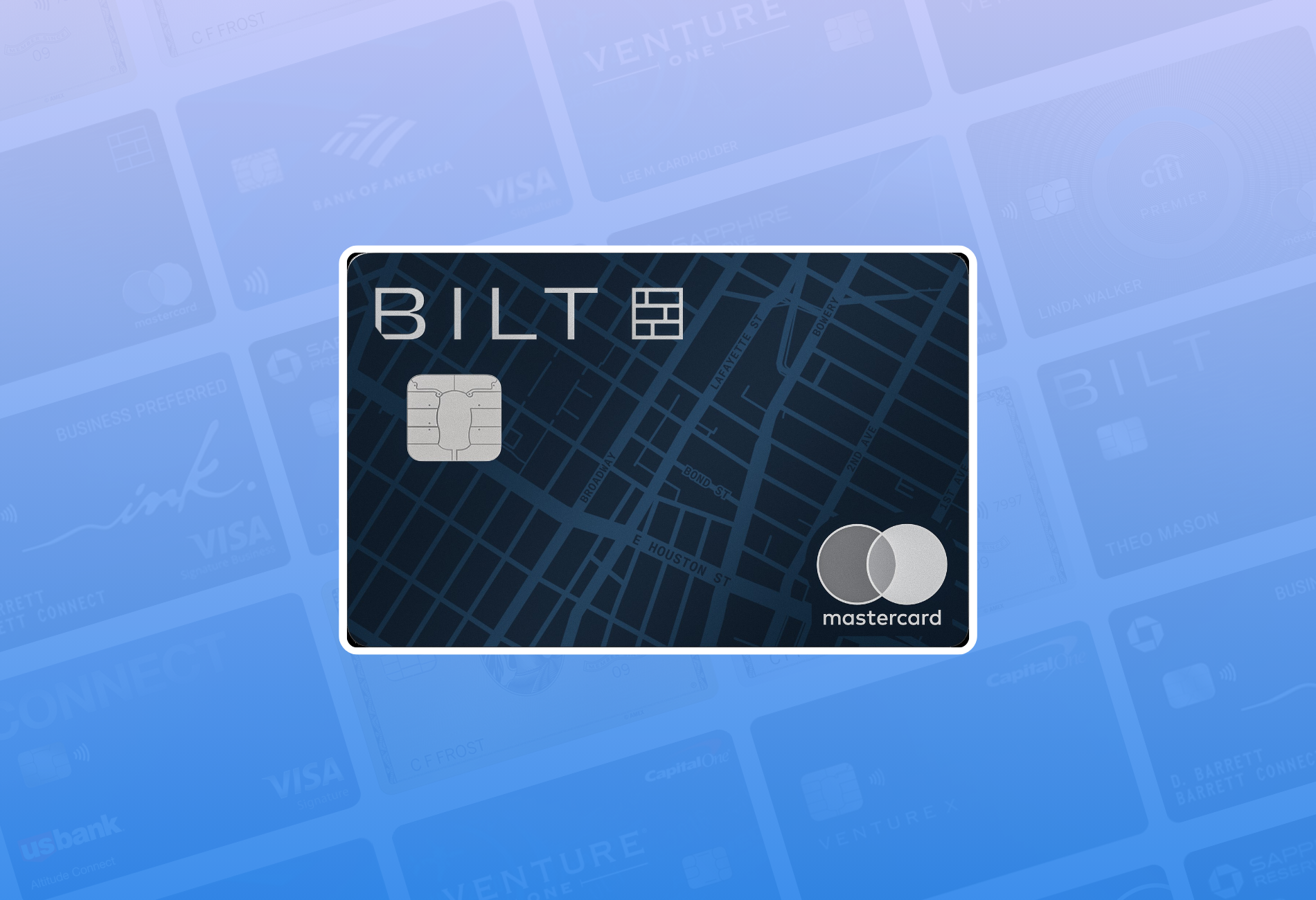
At a glance
- Best for: Introduction to Bilt Rewards
- Annual Fee: $0
- APR: 10% intro APR on new eligible purchases for 12 billing cycles after account opening. After the intro period, a variable APR of 26.74% – 34.74% will apply.
- Reward Rate: 1-1.25X
- Recommended Credit: 670-850
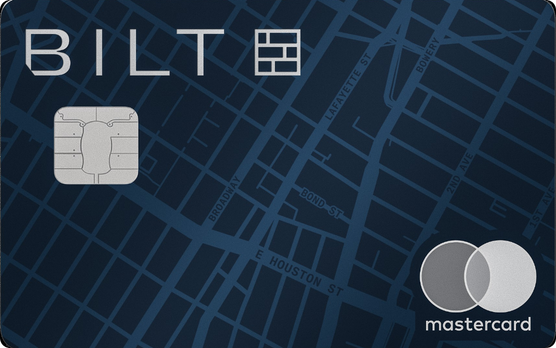
Bilt Blue Card
$100 of Bilt Cash
Offer Details:
Get $100 of Bilt Cash when you apply and get approved. Terms apply.
Why we like it
This card stands out for its everyday practicality and extra value. Cardholders can make housing payments with no transaction fees, helping keep major expenses cost-effective, while no foreign transaction fees make it a great companion for travel or international purchases.
Reward details
1x points on everyday spend
4% back in Bilt Cash on everyday spend
up to 1.25X points on rent and mortgage
Pros & Cons
Pros
No annual fee
Access to Bilt Rewards and Bilt Cash
Ability to link everyday spending with housing-related value
No foreign transaction fees
Cons
No elevated bonus categories
Requires active engagement to maximize value
Limited traditional “perks”
Not competitive as a standalone everyday rewards card
Terms Apply
Overview
Bilt’s looking a little different these days. While its points system remains the most valuable of any on the market, the simplistic credit card product we knew and loved has been replaced by three-tiered options catering to different customers. From the outside (and honestly from the inside, too), things look a little more complicated. But does complex mean it’s less valuable?
The bottom rung on the Bilt ladder is the Bilt Blue, a no-annual-fee product designed for entry-level points-and-miles to get their toes wet in the space. But does it live up to the expectations set by the previous model? And is it worth slotting into your own strategy?
Who is this card best for:
The Bilt Blue Card is built for people who want access to Bilt Rewards without paying an annual fee, and who are comfortable engaging with a rewards system that requires a bit of intention.
Rather than offering bonus categories or outsized welcome offers, the card takes a deliberately restrained approach to earning. Its value comes less from raw multipliers and more from participation in the broader Bilt ecosystem, where everyday spending and housing costs are linked through a mix of points and Bilt Cash.
This makes the Blue Card a strong fit for renters or homeowners who:
Want to explore Bilt without an upfront cost
Already have strong everyday cards elsewhere.
Are willing to actively manage how they earn and redeem rewards
If you’re looking for a card that passively racks up points without much thought, this won’t be it. But if you want a no-risk entry point into a genuinely different rewards model, the Blue Card can make sense.
The Bottom Line:
The Bilt Blue Card is a no-annual-fee gateway into one of the most unconventional rewards programs on the market. As you’ll read further in the article, it can’t replace your best everyday earner, but to take full advantage of the earnings on rent and mortgages, you may have to sacrifice elsewhere.
But for people curious about Bilt and willing to engage with how the system works, it offers access and flexibility without financial commitment. If you want simplicity above all else, look elsewhere. If you want optionality without paying for it, this card does exactly what it promises.
Intro Bonus
The Bilt Blue doesn’t come with too much in the way of an introductory offer. Successful applicants will receive $100 in Bilt Cash (not as simple as regular cashback), but other than that, it’s just access to the card you’re gaining. This is typical for a no-annual fee card, and if you’re looking to not spend, you can’t expect much across the board.
Pros & Cons
As with any tightly focused card, the Bilt Blue Card comes with clear strengths and equally clear limitations.
Pros
- No annual fee
- Access to Bilt Rewards and Bilt Cash
- Ability to link everyday spending with housing-related value
- No foreign transaction fees
- A low-risk way to test the Bilt ecosystem
Cons
- No elevated bonus categories
- Requires active engagement to maximize value
- Limited traditional “perks”
- Not competitive as a standalone everyday rewards card
Benefits & Perks
The Bilt Blue Card keeps things minimal on the perks front. There’s no lounge access, no premium credits, and no attempt to compete with high-end travel cards.
What you do get are practical, functional benefits:
No annual fee
No foreign transaction fees
Access to Bilt’s app, partners, and redemption options
Integration with Bilt’s points and cash framework
Cellphone protection
Again, if you’re searching for a no-annual fee card, this is par for the course.
Fees
This is where the Blue Card is easiest to evaluate.
With no annual fee,e there’s no pressure to justify keeping the card long-term. Considering the changes to the program and the complexities you’ll face, this is definitely a good thing.
Earning rewards & redeeming points
Earning rewards
This is where things get hairy. For a full breakdown of how this works, check out this article on Bilt 2.0, where we’ll go into depth on the intricacies of what is a complex system. For now, we’ll keep it surface level, and if you can’t keep up…well, neither did we at first.
Bilt Cash vs Bilt Points
The Bilt rewards system revolves around two forms of earned currencies: Bilt Cash and Bilt Points.
Bilt Points are similar to other credit card currencies, and are the ones we want to get our hands on. It’s these that we call the most valuable points in the market. You can transfer these to Bilt’s partners and enjoy outstanding value.
Bilt Cash, on the other hand, operates more as a kind of in-house cashback system. You can use it to cover rent payments or credit card transactions, or for affiliated dining and entertainment experiences. It’s worth noting that all but $100 of your Bilt Cash expires at the end of the calendar year.
What does the Bilt Blue earn?
With the Bilt Blue you can earn:
Up to 1.25x points on rent/mortgage payments
1x points on everyday purchases
4% Bilt Cash on everyday purchases (dependent on earning scheme choice)
Seems fairly simple, right? If you spend $1,000 on the card outside of your rent, you can earn 1,000 Bilt Points and $40 in Bilt Cash, depending on how you earn.
But you may have noticed the “up to” verbiage in the rent earnings line. That’s there because you have two methods of earning, and each have different outcomes that suit different people.
Option 1: Housing Only Rewards (otherwise known as “spend a ton”)
In this scenario, your rent and mortgage earnings are dictated by how much you spend elsewhere. The upside is that you’ll continue to enjoy fee-free payments on your rent or mortgage. The more you spend, the more you’ll earn from your housing costs. But here’s the kicker: the volume of spending is, in turn, dictated by the size of your rent or mortgage payment, as shown below.
Spend the equivalent of 25% of your rent/mortgage and earn 0.5x Bilt points on housing.
Spend the equivalent of 50% of your rent/mortgage and earn 0.75x Bilt points on housing.
Spend the equivalent of 75% of your rent/mortgage and earn 1x Bilt points on housing.
Spend the equivalent of 100% or more of your rent/mortgage and earn 1.25x Bilt points on housing.
So, the more you use the card, the more you get back from your rent or mortgage. For example, if your rent payment is $2,000, to get a 1x point per dollar rate on that payment, you’d need to spend $1,500 a month on the card. If you don’t meet any of the thresholds, you’ll get a measly 250 points. You won’t receive Bilt Cash if you choose this option.
Keeping up?
Option 2: Flexible Bilt Cash (otherwise known as confusing as hell, but maybe better for you?)
The second option requires you to pay a 3% transaction fee for your rent or mortgage, but in turn lets you earn a 1x point per dollar basis. The issue here is the fee. Bilt’s way for you to work around it is to use Bilt Cash to cover the costs.
Of course, similar to option one, this requires you to use the card on a day-to-day basis — and remember, rent and mortgage payments don’t accrue Bilt Cash.
Using the same $2,000 rent in the first option, I’d earn 2,000 points a month on my rent or mortgage. But I won’t earn that until I redeem $60 in Bilt Cash. I’d need to spend at least $1,500 on the card per month. In effect, you’re buying Bilt points with your own earnings.
Which is better?
It’s hard to say, as it is so situational.
Continuing that $2,000 rent scenario, here’s what it’d look like earning the maximum and minimum in each scenario without overspending.
Option 1 Max: I spend $2,000 on rent and $2,000 on everyday spend, and receive 4,500 points
Option 1 Min: I spend $2,000 on rent and $499 on everyday spending and receive 749 Points
Option 2 Max: I spend $2,000 on rent and $1,500 in everyday spend and receive 3,500 points. I would have used all my Bilt Cash for the month.
Option 2 Min: I spend $2,000 on rent, don’t spend day-to-day, and pay an extra $60 in fees.
You’ll be able to tell based on your own spending habits where you’ll fall on this spectrum and whether it’s worth it for you.
Redeeming
Thankfully, aside from the Bilt Cash thing, redeeming Bilt Points is still basically the same, and it’s pretty good. The best way to do it is to transfer points to one of its airline and hotel partners. It remains one of the strongest selections of partners out there, and you can get some serious value from them.
Here are all the airlines and hotels currently affiliated with Bilt:
Airlines:
Atmos Rewards (Alaska Airlines + Hawaiian Airlines)- 1:1
Avianca Lifemiles – 1:1
United MileagePlus® – 1:1
Air France/KLM Flying Blue® – 1:1
Virgin Red® – 1:1
Virgin Atlantic Flying Club – 1:1
Emirates Skywards® – 1:1
British Airways Executive Club – 1:1
Cathay Pacific – 1:1
Turkish Airlines Miles&Smiles – 1:1
Aer Lingus AerClub – 1:1
Iberia Plus – 1:1
Air Canada Aeroplan® – 1:1
TAP Miles&Go – 1:1
Southwest Airlines – 1:1
Japan Airlines – 1:1
Qatar Airways Privilege Club Avios – 1:1
Etihad Airways – 1:1
Spirit – 1:1
Hotels:
Hilton Honors – 1:1
Marriott Bonvoy™ – 1:1
World of Hyatt® – 1:1
IHG® One Rewards – 1:1
Accor Live Limitless – 3:2
Bilt Cash can be redeemed in different ways. Such as the following:
Statement credits within the Bilt ecosystem (not general cash back)
Credits toward rent or housing-related rewards (used to unlock additional Bilt Points on housing payments)
Dining credits at Bilt Dining partner restaurants
Food delivery credits with select Bilt partners
Hotel bookings through the Bilt travel portal
Transportation credits (rideshare and select mobility partners)
Experiences and events offered through Bilt (dining events, fitness classes, etc.)
Program features or boosts (used to enhance earning, transfers, or benefits inside Bilt)
Is this card right for you?
It’s a complicated question. If you’re desperate to be part of the Bilt ecosystem and can’t find a better use for your daily spending elsewhere, then it can work well for you. But opting for the lowest tier limits your power considerably and doesn’t add up mathematically in too many situations.
Remember, the point of these changes is to force you to spend on the card. You don’t get the housing rewards unless you do so. But, as a low-risk option, it can work great!
- Best for: Introduction to Bilt Rewards
- Annual Fee: $0
- APR: 10% intro APR on new eligible purchases for 12 billing cycles after account opening. After the intro period, a variable APR of 26.74% – 34.74% will apply.
- Reward Rate: 1-1.25X
- Recommended Credit: 670-850
Bilt Blue Card
$100 of Bilt Cash
Offer Details:
Get $100 of Bilt Cash when you apply and get approved. Terms apply.
Why we like it
This card stands out for its everyday practicality and extra value. Cardholders can make housing payments with no transaction fees, helping keep major expenses cost-effective, while no foreign transaction fees make it a great companion for travel or international purchases.
Reward details
1x points on everyday spend
4% back in Bilt Cash on everyday spend
up to 1.25X points on rent and mortgage
Pros & Cons
Pros
No annual fee
Access to Bilt Rewards and Bilt Cash
Ability to link everyday spending with housing-related value
No foreign transaction fees
Cons
No elevated bonus categories
Requires active engagement to maximize value
Limited traditional “perks”
Not competitive as a standalone everyday rewards card




 by your friends at The Daily Navigator