
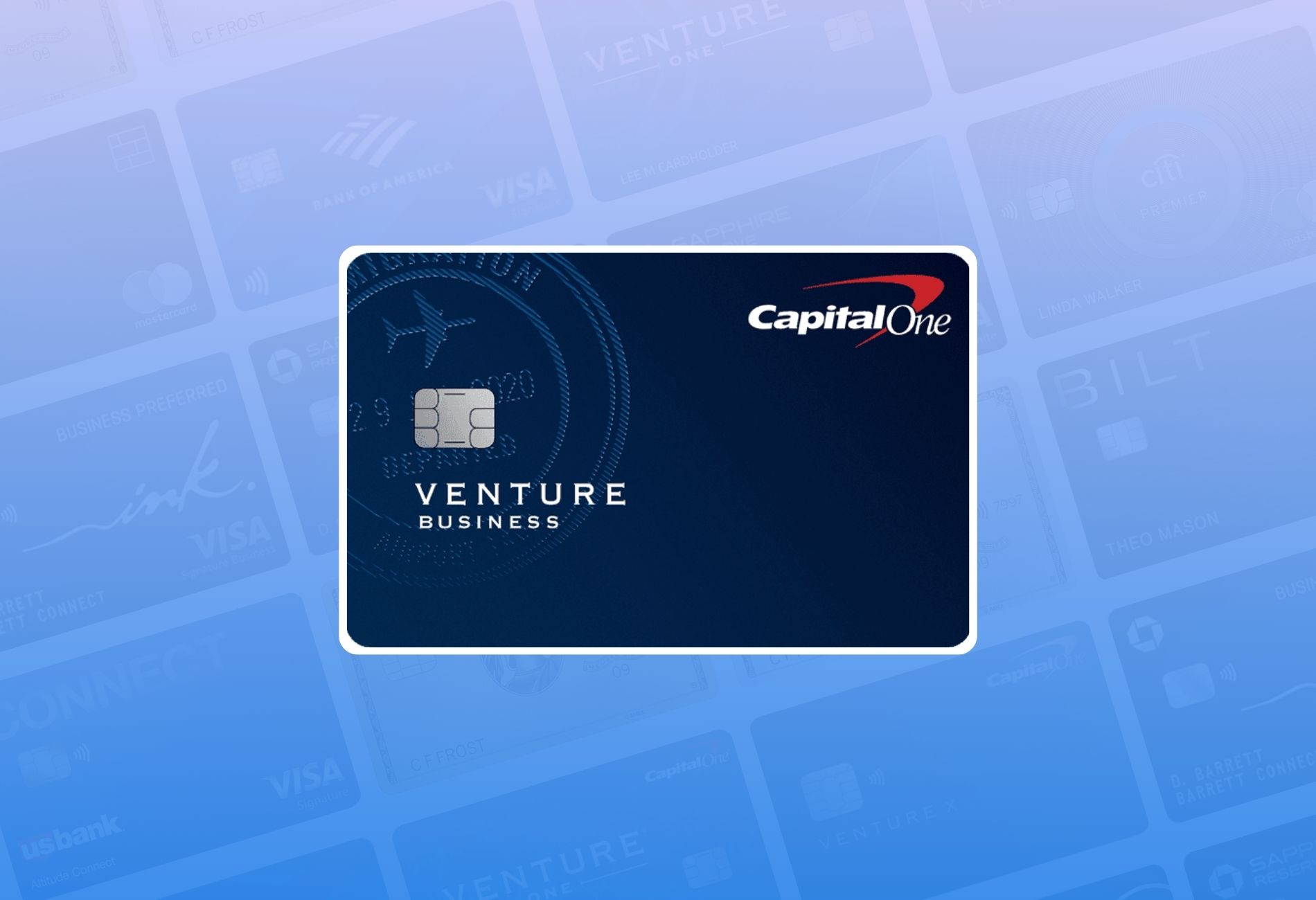
At a glance
- Best for: Business travelers who want to keep it simple

- Annual Fee: $95
- APR: 24.49% (Variable)
- Reward Rate: 2X-5X
- Recommended Credit: 740-850
Capital One Venture Business
Earn 100,000 bonus miles
Offer Details:
Earn 100,000 Miles once you spend $10,000 on purchases within the first 3 months from account opening
Why we like it
The Venture Rewards for Business offers the simplicity and high-earning potential of its premium competitors in a more affordable package. By stripping down the perks, but still allowing an impressive intro bonus for big spenders, it’s filling a smart gap in the market.
Reward details
Earn unlimited 2X miles per dollar on every purchase, everywhere, no limits or category restrictions, and miles won’t expire for the life of the account
- Unlimited 5X miles on hotels, vacation rentals and rental cars booked through Capital One Business Travel
Pros & Cons
Pros
Simple, flat-rate earning structure
Annual fee is approachable
Strong introductory bonus
Flexible miles with transfer partner options
Easy-to-use rewards with minimal effort required
No need to track categories or spending caps
A few decent credits to increase value
Cons
No high-end bonus categories
Fewer premium perks compared to top-tier cards
The tiered bonus structure may isolate some cardholders
Terms Apply
Overview
Capital One hasn’t had a shortage of business cards. From the high-end Capital One Venture X Business to the Spark line, there’s an option for everyone. The arrival of the new Capital One Venture Business (replacing the Spark Miles for Business option) fills yet another slot, allowing a new wave of business owners to maximize their outgoings.
With an approachable price point and the potential to earn two miles on every purchase, it could be the perfect autopilot card for small business owners with varied expenses. But where it succeeds in simplicity, it may struggle to take others’ earnings stratospheric in the way a more premium card can.
Let’s take a look at the ins and outs of Capital One’s newest business tool.
Who is this card best for:
The Capital One Venture Business is built for business owners who value simplicity above all else. If you don’t want to think about bonus categories, rotating spend, or jumping through hoops to earn miles, this card should be appealing.
It excels for businesses with broader spending patterns, as opposed to those tied down to high volumes in a specific category that could be maximized on a more specific card. It’s also worth noting that if your spending is high, you’re also upgrading to the Capital One Venture X Business, as you’ll get all the added bells and whistles.
The Bottom Line:
It’s the definition of a set-it-and-forget-it card. With a solid 2x miles per dollar earning rate on all purchases, the Venture Rewards Business is an affordable option for getting some serious returns on your varied business spending.
Intro Bonus
This card offers a solid introductory offer of 100,000 miles after spending $10,000 in purchases in the first 3 months from account opening. This is very approachable and opens the card up to many lower-spending setups.
100,000 is worth a minimum of $1,000 when spent on Capital One’s travel portal, but we’d stretch that valuation to well over $2,000 when transferring those miles to an airline or hotel partner.
Pros & Cons
The Venture Rewards for Business card has a lot going for it, but it’s by no means a perfect product. Here’s a high-level look at the good and the bad sides.
Pros
- Simple, flat-rate earning structure
- Annual fee is approachable
- Strong introductory bonus
- Flexible miles with transfer partner options
- Easy-to-use rewards with minimal effort required
- No need to track categories or spending caps
- A few decent credits to increase value
Cons
- No high-end bonus categories
- Fewer premium perks compared to top-tier cards
- The tiered bonus structure may isolate some cardholders
Benefits & Perks
Unlike its premium sibling, the Capital One Venture Business has a pretty short perks list. That’s not necessarily a bad thing, as that’s exactly what keeps the price point low while allowing cardholders to earn 2x miles on every dollar they spend. Still, if you’re looking for lounge access and other high-end extras, this isn’t the card for you. It does come with a few add-ons to make it easier to recoup that annual fee when the bonus has been and gone, though.
Global Entry or TSA PreCheck credit
The card comes with up to $120 Global Entry or TSA PreCheck credit, which covers the application fee for either program. A membership typically lasts around four years, so you’re covered for a good long while. If you’re unfamiliar with the programs, these help you move through security and immigration in the airport far more quickly. Generally, it’s best to go for the Global Entry, as it includes TSA Precheck in its application process.
$50 annual travel credit
The handiest perk offered by the Venture Rewards for Business Card is its $50 annual travel credit. You’ll need to use it on Capital One Business Travel, the issuer’s business-centric booking portal, but that’s immediately halving your annual fee costs, assuming you spend more than $50 a year on travel.
Annual $50 statement credit for business purchases
The Venture Rewards for Business also comes with a $50 annual statement credit for qualifying advertising or software purchases. As long as you use the card to pay for something with a merchant code that adds up, you’ll be good to go. It’s important to note that if you buy from a merchant that isn’t specifically in those fields, the credit won’t be triggered. For example, if you buy software from a supermarket that has a tech section, it probably won’t work.
Business-friendly features
As with most business cards, you’ll have add-ons like 0% fraud liability, purchase records, extended warranties, free employee cards, and customized spending limits depending on who is using the card.
Travel benefits
There are also a few extra travel benefits to enjoy, like Hertz Five Star Status, which lets you skip the counter at some locations and open up a broader selection of vehicles. There’s also the Lifestyle Collection perks, which unlock benefits like upgrades or experience credits at a line of luxury hotels on Capital One’s travel portal.
Fees
One of the most attractive aspects of the card is its annual fee. The ability to earn high volumes of miles for just $95 a year sets it apart from many of its competitors, especially for a business owner with lower outgoings or a high aversion to risk. Combined with the easy-to-use statement credits, it’s likely that most cardholders could have no problems cancelling out the fee with their return value.
Earning Rewards & Redeeming Points
Earning rewards
Above all else, the card’s earning rates are where the value truly shines. As with other Capital One models, this card uses a flat-rate system, offering cardholders 2x miles per dollar on every purchase with uncapped earnings. The only exception to that is the 5x miles per dollar rate on travel booked on the Capital One Business Travel Portal.
While 2x miles per dollar doesn’t sound exciting compared to a 4x points per dollar on restaurants or other specific spending categories, in most cases, it makes up the difference by ensuring you’re never earning just 1x miles per dollar. Unless you have high spending in a specific spending category that’s maximized elsewhere, this card can carry you a long way. The simplicity is a huge draw for many, too.
But if your monthly outgoings are around $10,000, the first year alone could pull you 390,000 miles, including the bonuses. $5,000 a month would pull 270,000 miles. That’s an impressive haul, especially considering you’re earning on autopilot.
Redeeming
From high-value transfers to basic statement credits and gift cards, Capital One offers many ways to redeem your miles. But they are most definitely not all created equal. Here are all the ways you can use your Venture Miles.
Transferring to Partners
The best way to use your miles, by a considerable margin, is to transfer your miles to one of Capital One’s airline and hotel partners. While using your miles elsewhere might get you 1 cent per mile, some of the transfer options could squeeze 2, 4, or even 8 cents per mile for any given redemption. It’s this method that gives the 100,000-mile bonus a valuation of well over $2,000.
Here is a list of all Capital One’s transfer partners, as well as the transfer ratio you’ll get for each.
Program | Transfer ratio |
Aeromexico Rewards | 1:1 |
Air Canada Aeroplan | 1:1 |
Air France-KLM Flying Blue | 1:1 |
All Accor Live Limitless | 2:1 |
Avianca LifeMiles | 1:1 |
British Airways Executive Club | 1:1 |
Cathay Pacific Asia Miles | 1:1 |
Choice Privileges | 1:1 |
Emirates Skywards | 1:1 |
Etihad Airways Guest | 1:1 |
EVA Airways Infinity MileageLands | 2:1.5 |
Finnair Plus | 1:1 |
JetBlue TrueBlue | 5:3 |
Qantas Frequent Flyer | 1:1 |
Singapore Airlines KrisFlyer | 1:1 |
TAP Air Portugal Miles&Go | 1:1 |
Turkish Airlines Miles&Smiles | 1:1 |
Virgin Red | 1:1 |
Wyndham Reward | 1:1 |
Using the Travel Portal
You can also redeem miles through Capital One’s travel portal at a fixed 1 cent per mile rate. It’s straightforward and doesn’t require any loyalty program knowledge, which appeals to many, but you’ll get less value on average than transferring. It operates in a similar manner to any travel aggregator like Expedia, Booking, or Skyscanner: just search for the hotel or flight you want, and select miles instead of cash. If the flight costs $1,000, you’ll need 100,000 miles. Simple.
Cash Back / Statement Credits / Gift Cards
Miles can be redeemed for statement credits or cash back, but at a lower value. It’s flexible, as you can spend your earnings on literally anything you want or offset costs elsewhere in the business, but in terms of true value, it’s limiting. You’ll generally get the same 1 cent per mile rate, although you can sometimes buy gift cards at a discount and improve that value.
Is this card right for you?
The Capital One Venture Business is an excellent option for business owners with varied expenses who want a simple way to earn miles. The strong intro bonus options offer a ton of miles to both low and high-spending businesses, while the accessible annual fee makes it a fairly low-risk card for those a little uncomfortable with the astronomical fees found on premium cards. Those looking for top-tier perks will need to look elsewhere, though.
- Best for: Business travelers who want to keep it simple
- Annual Fee: $95
- APR: 24.49% (Variable)
- Reward Rate: 2X-5X
- Recommended Credit: 740-850
Capital One Venture Business
Earn 100,000 bonus miles
Offer Details:
Earn 100,000 Miles once you spend $10,000 on purchases within the first 3 months from account opening
Why we like it
The Venture Rewards for Business offers the simplicity and high-earning potential of its premium competitors in a more affordable package. By stripping down the perks, but still allowing an impressive intro bonus for big spenders, it’s filling a smart gap in the market.
Reward details
Earn unlimited 2X miles per dollar on every purchase, everywhere, no limits or category restrictions, and miles won’t expire for the life of the account
- Unlimited 5X miles on hotels, vacation rentals and rental cars booked through Capital One Business Travel
Pros & Cons
Pros
Simple, flat-rate earning structure
Annual fee is approachable
Strong introductory bonus
Flexible miles with transfer partner options
Easy-to-use rewards with minimal effort required
No need to track categories or spending caps
A few decent credits to increase value
Cons
No high-end bonus categories
Fewer premium perks compared to top-tier cards
The tiered bonus structure may isolate some cardholders