
Overview
If you’ve flown United Airlines (or any airline, really), there’s a good chance you’ve received emails, texts, or in-app offers for the carrier’s co-branded credit cards. Now firmly part of the airline and loyalty program eco-system, these cards are a serious profit driver and an increasingly vital piece of any awards strategy.
They’re a tempting prospect; the promise of free travel, elevated perks, and elite-status shortcuts is attractive to just about anyone who’s glanced left during boarding a $1,000 economy flight. But it’s important not to get carried away. The wrong card can be a financial drain, losing hopeful customers hundreds of dollars a year in fees they can’t balance out.
Recent changes to the United MileagePlus program, which we’ll discuss soon, have emphasized the importance of the cards, making them a vital piece of any strategy concerning the airline. United has four personal co-branded cards geared at different types of travelers, so it’s important you opt for the right one. Thankfully, we’re here to break them down for you, as well as highlight the best ways to use them.
Why These Cards Are Becoming More Important
Before we introduce the cards, it’s important to look at recent changes to the MileagePlus program that make them so important. In a move that both mirrors other airlines and takes things further, United has moved away from a traditional earning system and placed a heavy emphasis on credit card spending.
In the past, the primary method of earning miles was to fly with the airline. Loyalty to the airline was rewarded with the opportunity to earn more miles and hit elite status, regardless of which credit card the customer had in their wallet. But as of April 2nd, it has almost halved the earning rates for non-cardholders, allowing those who open a card to earn far more. It’s effectively become a buy-in system. In the most extreme examples, non-cardholders won’t earn anything on basic economy flights. Cardholders, meanwhile, will enjoy 10% off specific award flights.
If you’re in any way interested in MileagePlus miles or use the airline more than once or twice a year, it’s worth checking these cards out, even if you’re a bit miffed they’re forcing your hand.
United Gateway℠ Card: The Entry-Level Option
The United Gateway℠ Card is the most straightforward option in the lineup, and it’s the only card without a fee.
But annoyingly, it comes with some serious caveats. Unless you spend $10,000 in a calendar year, you won’t have access to the higher cardmember earning rates. So if you’re looking to earn, it’s not a great option. The one main draw of the card for those with an eye on points and miles is the access to the 10% or more discount on Economy Saver Awards.
If you typically transfer points to United from a Chase card and rarely earn directly with the airline, it’s worth looking at this card. Otherwise, leave it alone; $10,000 on a transferable points-based card, like the Chase Sapphire Preferred® Card, is far more valuable. Even its perks, like free checked baggage, have the same $10,000 paywall.
The upside is the ability to grab 40,000 bonus miles after spending just $1,000 within three months of opening an account. It might be worth it for the small boost in miles.
- Best for: Occasional United customers

- Annual Fee: $0
- APR: 19.99% - 28.49% Variable
- Reward Rate: 1X-5X
- Recommended Credit: Good to Excellent
United Gateway℠ Card
Earn up to 50,000 bonus miles
Offer Details:
Earn 40,000 bonus miles after you spend $1,000 on purchases in the first 3 months your account is open. Plus, 0% intro APR for 12 months from account opening on purchases.
Why we like it
The United Gateway Card fits a specific customer profile, but serves them well. Its 2x miles per dollar earning rate and 40,000 mile bonus will help give infrequent United flyers a little boost and potentially cover a flight or two. Regular travelers might want something more comprehensive, but for a no-annual fee product, the Gateway pulls its weight.
Reward details
-
5x total miles on eligible United flights and 2x miles on all other eligible United® purchases
-
2x miles at gas stations, and on local transit and commuting
-
1x mile on all other purchases
Pros & Cons
Pros
-
Solid intro bonus
-
No annual fee
-
Strong earning in high-spend categories
-
Earn 2 checked bags after you spend $10,000 in a calendar year
Cons
-
Regular flyers can do better
-
Miles aren’t transferable
Terms Apply
United℠ Explorer Card: The Sweet Spot
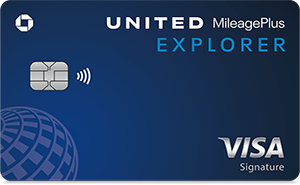
The United℠ Explorer Card might be the card that ticks the most boxes for the most people. There’s no $10,000 spending threshold to start earning the higher rates of 6x miles per dollar or 9x miles per dollar on flights when paying with your card, which immediately makes it more accessible.
Honestly, as a co-branded card, it might be one of the best on the market. It costs $150 a year, but waives the fee in the first year and boasts a ton of perks rarely seen on cards that sit in this price point. You’ll get your first checked bag free (plus one companion’s), priority boarding, two United Club lounge passes (super impressive), and over $500 in annual partner credits.
The partner credits are hit or miss depending on your lifestyle, but the $100 travel credit, hotel credit, and Rideshare credits can probably work for most people and more than validate the $150 fee in themselves. You can also grab a Global Entry, TSA PreCheck, or NEXUS fee credit, too.
The intro bonus is generous, too. It’s currently offering 70,000 bonus miles after spending $3,000 within three months of opening the card. That’s no paltry sum, and with a super achievable spending target, too. When you combine that with the upcoming changes, it sets itself apart as the best card for the casual United Flyer. Flying once or twice a year with the airline can more than validate its presence in your wallet.
I still don’t necessarily advise using it daily. You can still earn better with transferable points cards, but it pulls its weight.
- Best for: Travelers near a United hub
- Annual Fee: $0 introductory annual fee for the first year, then $150
- APR: 19.99% - 28.49% Variable
- Reward Rate: 1X - 2X
- Recommended Credit: Good to Excellent
United℠ Explorer Card
Earn up to 80,000 bonus miles
Offer Details:
Earn 70,000 bonus miles after you spend $3,000 on purchases in the first 3 months your account is open.
Why we like it
The United℠ Explorer Card is a strong card for its price point. No other comparably priced card includes lounge access along with the more typical free checked bags, a solid bonus offer, and priority boarding. Considering the $150 annual fee is waived for the first year, if any United or Star Alliance flights are on the horizon, it could be worth giving a test drive.
Reward details
9x total miles on eligible United flights
3x miles on all other eligible United® purchases
2x miles on dining, and hotel stays when booked with the hotel
1x mile on all other purchases
Pros & Cons
Pros
-
Great intro bonus
-
Cardholders enjoy two one-time passes to the United Club a year, usually worth $59 each. *Cardmember or authorized user must be present when they are redeemed.
-
Priority boarding privileges.
-
Access to expanded award availability makes booking United flights with miles easier and cheaper.
-
Free first checked bag for the cardholder and a companion can justify the annual fee with one round-trip flight.
-
A year’s membership to DoorDash’s DashPass is a nice addition for those who use the food delivery service.
-
The up to $120 credit for Global Entry/TSA Precheck® pass is great for regular travelers.
Cons
-
The DashPass and Global Entry/TSA perks are great, but only helpful for some and overlap with other cards.
-
Without using the perks available, the fee can become harder to justify unless you’re a regular United flyer.
Terms Apply
United Quest℠ Card: For Frequent United Travelers
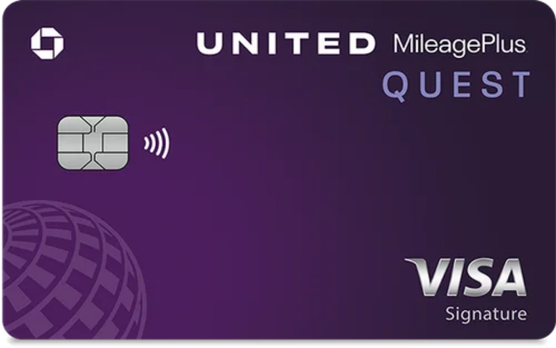
The United Quest℠ Card sits in a bit of an awkward middle ground in the lineup. It costs $350 a year, which immediately pushes it out of casual territory, but doesn’t quite reach the premium perks that justify the jump the way some higher-end airline cards do.
That said, if you fly United with any real regularity, it does start to make sense pretty quickly. Aside from the bonus (get to that in a sec), the biggest draws are the $200 annual United travel credit and two free checked bags. Those alone are worth up to $560 after one round-trip with two people, which helps take the sting out of that annual fee. It also has higher elite status earning potential, something to consider if that’s important to you.
Oddly, it doesn’t come with any lounge access, despite costing more than the Explorer Card, but it does have the Global Entry, TSA PreCheck, and Nexus credits, plus a few others like the $150 Renowned Hotels and Resorts Credit.
Its intro bonus is solid, offering 80,000 miles after spending $4,000 within three months of opening the card and 500 PQPs after your first purchase.
- Best for: Regular United customers
- Annual Fee: $350
- APR: 19.99% - 28.49% Variable
- Reward Rate: 1X-10X
- Recommended Credit: Good to Excellent
United Quest℠ Card
Earn up to 90,000 bonus miles and 500 PQP
Offer Details:
Earn 500 Premier qualifying points after your first purchase and 80,000 bonus miles after you spend $4,000 on purchases in the first 3 months your account is open.
Why we like it
The United Quest℠ Card fills a gap for regular United flyers who aren’t quite ready to make the jump to a full-blown premium card but deserve more for their spending than paltry earning rates. The annual $200 United credit does a lot of the heavy lifting for validating a place in your wallet, along with the 10,000 bonus miles and free checked bags. The 10x miles per dollar on United flights is an impressive haul, too.
Reward details
Earn 10x total miles on eligible United flights.
Earn 4x miles on all other eligible United® purchases.
Earn 2x miles on dining, select streaming services & all other travel.
Earn 1x mile on all other purchases.
Pros & Cons
Pros
$200 annual United travel credit offsets a big chunk of the fee
Anniversary award discount (up to 10,000 miles)
Free first and second checked bags
Priority boarding and decent travel perks
Solid earning on United purchases
Cons
No lounge access
Still a fairly high annual fee for a mid-tier card
Best value is heavily tied to flying United specifically
Terms Apply
United Club℠ Card: The Premium Experience
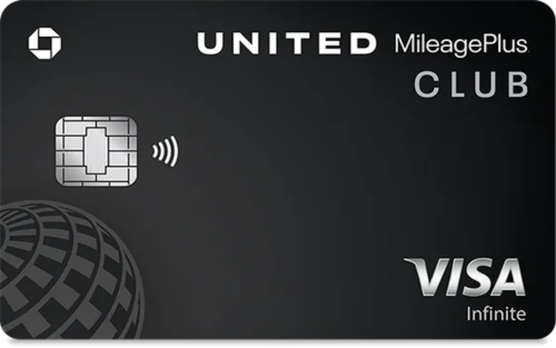
The United Club℠ Card should be reserved for serious United customers. With a high price point of $695 a year, it’s not one to open without considering its value to you. With that said, regular flyers can get more than enough out of it to validate that expense. In reality, if you’re the clientele for this card, the new changes will benefit you greatly.
Its bonus is 90,000 miles, earned by spending $5,000 within three months of opening an account, which is already enough to scrape back almost two years of the annual fee. It also comes with a United Club All Access membership for you and a guest. The pass itself is valued at $750, so if you were going to pay for it in the first place, the card is a no-brainer.
It offers almost everything the others offer, like two checked bags, the speedy airport security credits, priority boarding, over $800 in partner credits, and even ramps up the award flight discounts to as much as 20,000 miles. It goes above and beyond by adding elite status with IHG and Avis, and allows you to boost your PQPs for the year up to 28,000, along with a 1,500 bonus each year.
There’s a lot going on here, but this is really only a card for true United fans who fly the airline regularly. It opens up a path to elite status and throws in the luxury perks you need to make a premium card worth it at this price.
- Best for: United fliers who want lounge access
- Annual Fee: $695
- APR: 19.99% - 28.49% Variable
- Reward Rate: 1X - 11X
- Recommended Credit: Good to Excellent
United Club℠ Card
Earn up to 100,000 bonus miles
Offer Details:
Earn 90,000 bonus miles after you spend $5,000 on purchases in the first 3 months from account opening.
Why we like it
United’s high-end offering is the real deal. Offering the best earning options for the airline, unparalleled lounge access, and priority everything, it’s built for frequent United customers. Its annual fee is high, but if you’re intending to drop money on a United Club membership, it’s almost paid for itself anyway. It’s one of the best co-branded premium cards out there.
Reward details
11x total miles on eligible United flights
5x miles on all other eligible United® purchases
Earn 5x miles on all other eligible United® purchases.
Earn 2x miles on dining and all other travel.
Earn 1x mile on all other purchases.
Pros & Cons
Pros
Full United Club lounge membership for you and a guest!
Priority check-in, security, and boarding (Premier Access)
Free first and second checked bags
Strong travel protections
High earning on United flights
Cons
Very high annual fee
Value drops off hard if you don’t use lounges regularly
Limited appeal if you’re not loyal to United
Terms Apply
Earning Rates Table
United recently changed the way its customers earn MileagePlus Miles. In the past, it was a simple tiered earning system, but it now favors cardholders greatly. If you’re serious about earning United Miles, one of the cards mentioned in this article is an indispensable tool. Whether this is a good thing, is up for debate, but it’s not something you can change.
Here are the new earning rates.
Status | MileagePlus earn rate | Cardmember earn rate |
|---|---|---|
General member | 3 miles per dollar | 6 miles per dollar |
Premier Silver | 5 miles per dollar | 8 miles per dollar |
Premier Gold | 6 miles per dollar | 9 miles per dollar |
Premier Platinum | 7 miles per dollar | 10 miles per dollar |
Premier 1K® | 9 miles per dollar | 12 miles per dollar |
It’s super important to note that if you own either the United MileagePlus® Debit Rewards Card and United Gateway℠ Card, you won’t be eligible to earn the cardmember rates until you hit $10,000 of spending on the card in a calendar year.
There’s also the new addition of Basic (or Base) earning rates. These stripped-down tickets offer lower earning rates, regardless of your Premier status. These also apply to business class tickets if you so choose. Here’s what you’ll earn on one of those tickets.
Status | MileagePlus earn rate | Cardmember earn rate |
General member | – | 3 miles per dollar |
Premier Silver | 2 miles per dollar | 5 miles per dollar |
Premier Gold | 3 miles per dollar | 6 miles per dollar |
Premier Platinum | 4 miles per dollar | 7 miles per dollar |
Premier 1K | 6 miles per dollar | 9 miles per dollar |
That means, in theory, you could book a business-class flight for thousands of dollars and not earn a single mile if you don’t have one of United’s cards.
How To Use These Cards
How you use these cards depends heavily on what kind of customer you are. For some, they will be purely practical in a few situations, while others will see them as the center of a broader United-focused strategy.
If you’re a casual United flyer, I’m talking two to four flights a year, don’t bother with the premium cards. The Explorer card opens up the 10% award discount that starts in April, and lets you save money on checked bags, which offsets the fee each year. Two round-trip flights a year by yourself, or one round-trip with a partner, is almost the cost of the annual fee, so anything beyond that is a saving for you. Throw in the bonus, and you’ve got yourself a few free flights.
If you’re hellbent on elite status, you’ll want to focus on the two more expensive options. Flying upwards of four times, but preferably more, can validate one of those cards. The Club Card is a must for regular business travelers with United, as the lounge access and PQP opportunities aren’t matched in any other way. It’s one of the few situations where it might be worth opting for the expensive card over a general earner.
For anyone else, take it on a case-by-case basis. If you feel like you transfer points to United regularly enough to need the 10% award discount, then take a look at the Explorer Card. Otherwise, start looking at other airlines in the alliance, like Air Canada.
The Point
United’s program overhaul puts a heavy emphasis on credit card usage, meaning the average customer can no longer take advantage of award rates in the same way. Choosing to open a United card will depend heavily on your personal tendencies and whether you can squeeze value out of it. Regular United flyers, and honestly even occasional ones, will find something here to work with, as long as you’re playing by the airline’s rules.