Overview
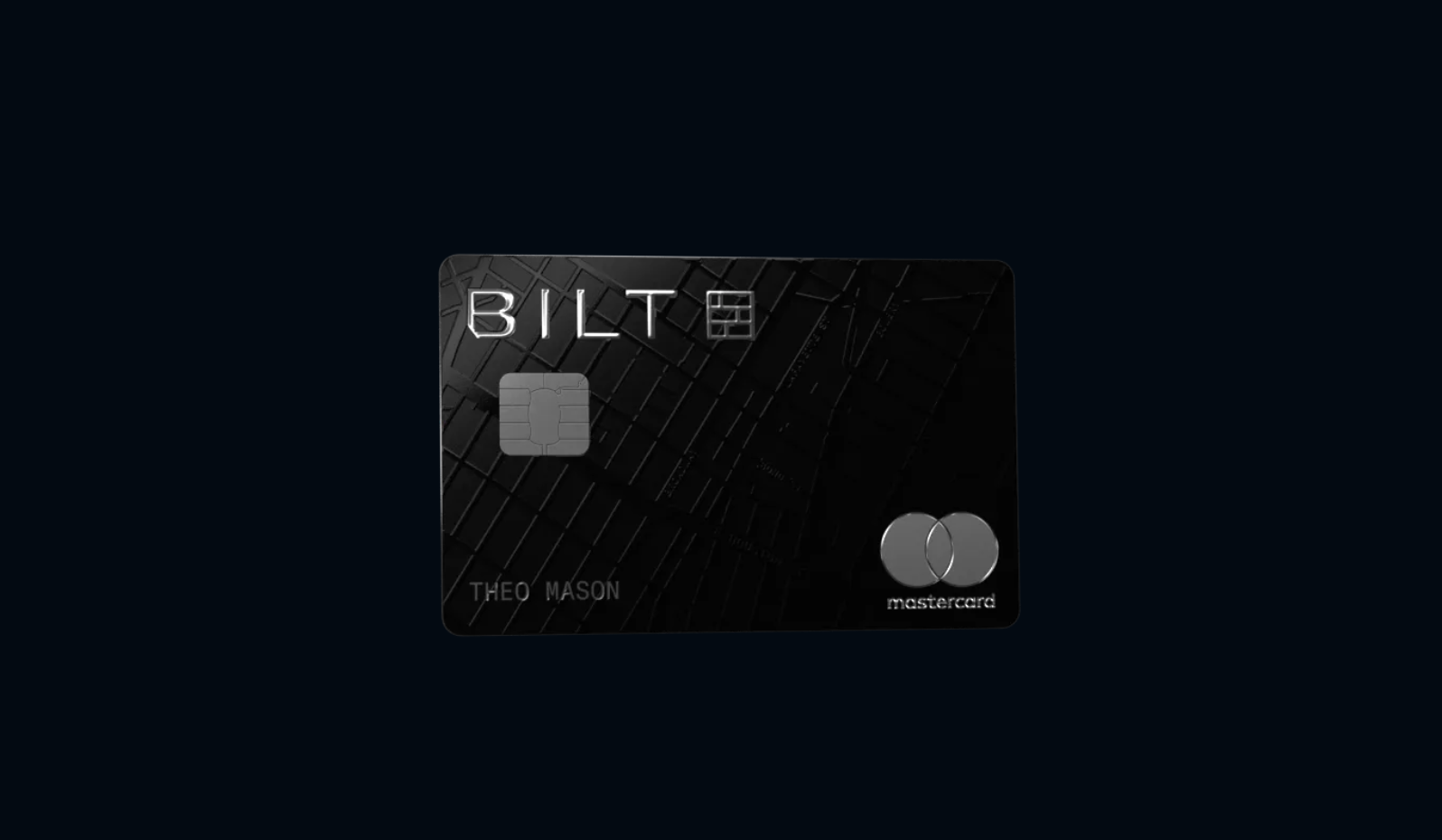
Bilt’s spent the last few years as the darling of the points and miles world. From introducing the first no-annual fee card designed to earn points on rent, to building the most valuable rewards currency in the space, the issuer could do no wrong.
But after Wells Fargo, the bank supporting the Bilt Mastercard, ended its partnership with the company — most likely because it was swallowing all the fees from the incredibly generous program — we knew things were about to change.
And change they did.
Bilt hinted at major developments over the coming months, teasing the prospect of earning on mortgages, as well as multiple avenues for earning at different price points. Bilt 2.0 is what emerged, taking the company in a radically different direction.
The revamped system is a complex one, revolving around three distinct cards, two reward currencies, and two separate ways to earn. Bilt’s angling for its cards to become a central piece of your credit card strategy, and it succeeds in many ways, while disappointing in others. This isn’t a program to get involved in uninformed, so let’s take a deep dive into the ins and outs of Bilt 2.0.
What Did Bilt Look Like Before?
Bilt’s previous model centered around the Bilt Mastercard. Marketed as a way to earn points on your rent, customers could pay their housing bills via credit card or have Bilt do it by check on their behalf if the landlord didn’t accept plastic. If you lived in a Bilt Alliance building, you only needed the app, but the majority of users were utilizing the credit card.
With the card or app, you earned 1x points per dollar on every dollar of rent you paid up to $100,000 each calendar year. The card was free to use, too, making it a no-brainer for most people. Rent has long been one of the points and miles game’s most gaping holes, and Bilt filled it with simplicity and generosity. The only stipulation to earning was that you used the card five times within each billing cycle. It didn’t matter how small those purchases were, just that you used it.
The strength of the program was bolstered by its incredible transfer partner list. The array of high-value airline and hotel options has made it the most powerful points currency available, something that’s still true today.
It also had some pretty strong earning rates on dining and travel, matching similar cards like the Chase Sapphire Preferred, giving customers a decision to make in terms of which system they wanted to prioritize. On top of all this, Bilt Rent Day, the first of every month, offered fun ways to grab bonus points and one-day-only perks like transfer bonuses.
All in all, it was a wonderful program that offered real value with very little hard investment.
In other words, it was always going to change.
What is Different?
Pretty much everything, if we’re being honest.
The Bilt Mastercard is gone, with those who chose to keep it open seeing it transitioned into the Wells Fargo Autograph card. The transfer partners have remained strong, but the methods of earning have been completely overhauled, forcing customers to use the new cards more for everyday purchases to get the opportunity to earn on their housing.
Mortgage payments have been added to the mix, which is a big positive, and the three new tiered cards have strong arguments in their own right for a position in your wallet. The greatest change, though, is the commitment required to any of the cards.
Maximizing these products requires a degree of investment in the Bilt ecosystem that no other issuer demands, and the numbers may not add up for some of its previous core markets. Make no mistake, this is a different system than it was before.
How Do You Earn in the New System?
Bilt has introduced three new credit cards to replace the Bilt Mastercard. We’ll look at each in depth later, but they all share roughly the same earning model, albeit with different rates. It’s no longer as simple as setting up rent or mortgage payments on these cards and letting the points roll in. You’ll now have other factors to consider.
Bilt Points and Bilt Cash
Instead of simply earning Bilt Points (the valuable currency transferable to airlines and hotels), Bilt products now earn using two separate metrics: Bilt points and Bilt Cash.
Bilt Points remains the traditional transferable currency. You can shoot them off to an airline or hotel, use them on Bilt Travel for 1.25 cents a point, or redeem them for less value by applying them to rent payments, adding to a down payment fund, grabbing gift cards, or covering purchases on Amazon. Each card earns Bilt Points on everyday spend at different rates and on rent/mortgage payments on a conditional basis (we’ll elaborate soon).
Bilt Cash is a separate currency. Depending on decisions made by the customer, it’s earned at a 4% flat-rate on all non-rent or mortgage spend on each card. Regardless of decisions made, customers will also earn $50 for every 25,000 points. This can’t be transferred in the same way as Bilt Points. Instead, it can only be used within the Bilt ecosystem. There’s a long list of ways you can use it, from dining and travel experiences to offsetting fees on rent payments. The exact value of Bilt Cash, while it claims to be $1:$1, is yet to be fully established for a number of reasons. It’s also worth noting that all but $100 of Bilt Cash will expire at the end of every calendar year.
The two currencies are designed to be earned and used in tandem. But for all the apparent generosity this portrays, it’s what makes things a little murkier going forward.
Two ways to earn
Instead of a simple spend-and-earn system, Bilt is offering customers two distinct routes. It’s no longer possible to earn almost exclusively from your housing costs without using the card for everyday spending. Here are Options 1 and 2 (also confusing, as Option 2 was introduced first, and Option 1 came a day or two after the initial release because everyone was confused).
It’s important to note that it’s possible to switch between the two systems on a monthly basis. So if you realize one works better for you, you’re not trapped.
Option 1: Housing Only Tiered Rewards
The housing-only option sees the customer’s housing reward rates set by the accompanying everyday spend. In short, the more you spend on everyday stuff, the more you earn on your rent or mortgage costs. There are no fees attached to this method, technically making it the most straightforward The rates are as follows:
Spend the equivalent of 25% of your rent/mortgage and earn 0.5x Bilt points on housing.
Spend the equivalent of 50% of your rent/mortgage and earn 0.75x Bilt points on housing.
Spend the equivalent of 75% of your rent/mortgage and earn 1x Bilt points on housing.
Spend the equivalent of 100% or more of your rent/mortgage and earn 1.25x Bilt points on housing.
If you fail to hit the 25% mark, you’ll receive 250 points.
So, assuming your rent was $2,000 a month, your non-housing spend would need to equal $500 to get 1,000 Bilt Points, $1,000 to get 1,500 Bilt Points, $1,500 to get 2,000 Bilt points, and $2,000 to get 2,500 Bilt Points. Of course, you’d also earn from your everyday spending. These rates will differ depending on the card you have.
It feels straightforward enough, but it’s also worth noting that you’re not actually rewarded for spending more. The sweet spot is technically the 25% mark, where you’re effectively getting 5x points per dollar on your everyday spending, if you accept not earning on the rest of your rent.
For example, if you keep the $2,000 rent rate, open the Obsidian card, and spend $500 on dining/groceries at 3x points per dollar, you’re getting 2,500 points in total. That works out to 5x points per dollar on your dining costs. On the other hand, if you were to spend $2,000 on dining/groceries, unlocking the 1.25x points per dollar on your rent, you’d wind up with 8,500 points at a 4.25 points per dollar rate.
Obviously, 0.75 points per dollar isn’t a huge amount. But if you’re serious about your points and miles, an extra $1,500 a month could comfortably go towards an introductory bonus on another card, which could grab you upwards of 18 points per dollar.
It’s complex, we know.
Option 2: Flexible Bilt Cash
Option 2 (which was announced before Option 1) is Flexible Bilt Cash. In this scenario, there are no “fees” as such, but the mechanism in place pretty much becomes one. After choosing this option, you’ll earn on everyday spend at whatever rate your specific card can. On top of this, you’ll earn 4% Bilt Cash on the same spend.
As mentioned before, Bilt Cash is a program-specific currency that can be used for a number of things within the Bilt ecosystem. The primary use is to unlock earnings from rent or mortgage payments. $30 of Bilt Cash unlocks 1,000 points on rent earnings. Using the same $2,000 rent from the previous example, a customer would need $60 in Bilt Cash to earn 2,000 Bilt Points from their rent. To earn enough $60 in Bilt Cash, they’d need to spend $1,500 on everyday spending. There are no tiers here, so whatever you unlock is capped at that 1x point per dollar rate.
Customers don’t need to use all of their Bilt Cash on this. They can opt to redeem fewer points and earn the respective number of points from their rent. For example, if the customer with $2,000 in rent payments opted to only redeem $30 in Bilt Cash on their rent, they’d only earn an extra 1,000 points instead of the full 2,000.
On top of all this, the Bilt Cash can be used to trigger earning accelerators. By parting with $200 in Bilt Cash, the customer adds 1x point per dollar to their everyday spending. So a flat-rate 2x point per dollar rate would become 3x points per dollar, a 3x point per dollar dining rate would become 4x points per dollar, and so on. It’s only possible to trigger these accelerators five times a year,r and each accelerator only lasts for a month – but it’s a significant boost.
Which is better?
The answer to that question relies on a few different factors. The most significant of those is the customer’s primary goal. If the aim is to maximize every dollar they spend, they might find value in capping their card’s spend to 25% on Option 1. If they have a high everyday spend in relation to their rent, Option 2 can provide a better return.
The issue that arises with the Bilt system is that earning from housing is no longer straightforward. There are stipulations that keep you tied into the ecosystem before it even lets you get to the elusive rent or mortgage earnings.
The higher-end cards can provide some up-front value to cushion any immediate devaluations, but beyond the first year will depend heavily on intention and, to be frank, how much you care — not everyone wants to be tracking spend, two separate currencies, and making decisions as to where to allot different things each month.
If you want a one-card catch-all system that covers all of your spending, then have at it. But if you’re more inclined to lean into points and miles strategy, you have a lot to consider. But, in theory, any of the cards could fall into a broader strategy. You just need to do the math.
The Cards
We’ve written individual articles on each of Bilt’s new cards, so we won’t spend an age covering them here, but we can run over the highlights so you can see how they might fit into your strategy.
The big thing to remember when looking at these is: without these cards, you don’t earn on your rent or mortgage. It’s not an earning category you can casually grab from anywhere. With this way of thinking, try to view the rent payments as a bonus spent on your day-to-day earnings.
The Bilt Blue Card
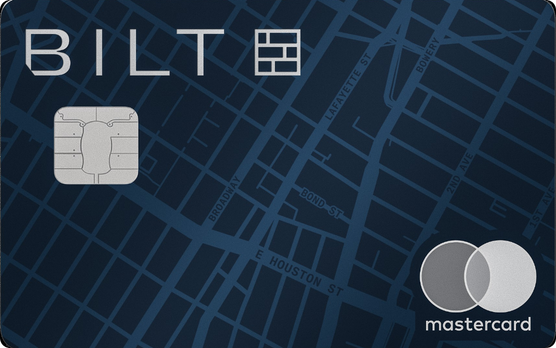
The Blue Card is the lowest-tiered card and is free to own. As such, there’s no bonus outside of a $100 Bilt Cash injection upon approval. It earns just 1x point per dollar on all non-housing spend, with up to 1.25x points per dollar on rent and mortgage payments, depending on which of the two earning options you choose.
It’s a pretty underwhelming card in the grand scheme of things and will pose a challenge for anyone hoping to earn a significant amount. If you’re just in a “something is better than nothing” mood, hitting the 25% sweet spot is a decent idea with Option 1.
- Best for: Introduction to Bilt Rewards
- Annual Fee: $0
- APR: 10% intro APR on new eligible purchases for 12 billing cycles after account opening. After the intro period, a variable APR of 26.74% – 34.74% will apply.
- Reward Rate: 1-1.25X
- Recommended Credit: 670-850
Bilt Blue Card
$100 of Bilt Cash
Offer Details:
Get $100 of Bilt Cash when you apply and get approved. Terms apply.
Why we like it
This card stands out for its everyday practicality and extra value. Cardholders can make housing payments with no transaction fees, helping keep major expenses cost-effective, while no foreign transaction fees make it a great companion for travel or international purchases.
Reward details
1x points on everyday spend
4% back in Bilt Cash on everyday spend
up to 1.25X points on rent and mortgage
Pros & Cons
Pros
No annual fee
Access to Bilt Rewards and Bilt Cash
Ability to link everyday spending with housing-related value
No foreign transaction fees
Cons
No elevated bonus categories
Requires active engagement to maximize value
Limited traditional “perks”
Not competitive as a standalone everyday rewards card
Terms Apply
The Bilt Obsidian Card
The Obsidian Card adds some strong bonus spending categories to mix, along with a $95 annual fee, and tacks on $200 in Bilt Cash. With 3x points per dollar in either dining or groceries (you need to choose), 2x points per dollar on travel, and 1x points per dollar on everything else, it makes a good case to be included in your day-to-day spending regardless of the rent question.
It’s a similar earning rate to the Chase Sapphire Preferred, and if your dining or grocery bills add up to 25% of your rent or mortgage costs, you’re technically grabbing 5x points per dollar on that category. That’s 30,000 points a year with the $2,000 rent example. That’s a pretty solid deal.
The Bilt Palladium Card
Bilt’s first foray into the premium market is the Palladium Card. It’s the only card in the lineup boasting a true intro bonus, and comes with perks we’ve come to expect from a more expensive card. The card costs $495 a year and offers 50,000 Bilt Points and $300 in Bilt Cash after spending $4,000 within three months of opening an account. It even throws in Gold Status for good measure.
It has a flat 2x points per dollar earning rate on all everyday spending, and offers the same choice-dependent rates for housing as the other two cards. Again, the 25% sweet spot offers the most bang-for-your-buck, with 4x points per dollar. Considering that covers literally anything you spend on, that’s pretty good, too. You just need to make sure the amount you earn validates spending almost $500 a year on the card. The $2,000 rent example would only yield 24,000 points a year at an everyday spending rate of 25% of of rent.
The intro bonus helps immensely with value, especially in the first year, as does the annual Bilt Cash Bonuses. This could make Option 2 much more attractive, as you already have a pretty big head start in covering things. For example, the $300 Bilt Cash intro bonus would cover five months of the rent,t 3% Bilt Cash fee required to trigger earning on rent. That means you’d be earning 2,000 points on rent plus 2x points on anything else you purchase without thinking about anything else. Throw in lounge access and some decent travel credits, and it’s got serious potential.
This card’s value will be strongly dictated by how much you spend. Higher spenders who value simplicity can do well with it, while the Obsidian may be more attractive for those with less and more specific outgoings.
What about Redeeming Bilt Points and Cash?
Thankfully, aside from the Bilt Cash thing, redeeming Bilt Points is still basically the same. The best way to do it is to transfer points to one of its airline and hotel partners. It remains one of the strongest selections of partners out there, and you can get some serious value from them.
Here are all the airlines and hotels currently affiliated with Bilt:
Airlines:
Atmos Rewards (Alaska Airlines + Hawaiian Airlines)-1:1
Avianca Lifemiles -1:1
United MileagePlus® -1:1
Air France/KLM Flying Blue® -1:1
Virgin Red® -1:1
Virgin Atlantic Flying Club -1:1
Emirates Skywards® -1:1
British Airways Executive Club -1:1
Cathay Pacific -1:1
Turkish Airlines Miles&Smiles -1:1
Aer Lingus AerClub -1:1
Iberia Plus -1:1
Air Canada Aeroplan® -1:1
TAP Miles&Go -1:1
Southwest Airlines -1:1
Japan Airlines -1:1
Qatar Airways Privilege Club Avios -1:1
Etihad Airways -1:1
Spirit -1:1
Hotels:
Hilton Honors -1:1
Marriott Bonvoy™ -1:1
World of Hyatt® -1:1
IHG® One Rewards -1:1
Accor Live Limitless -3:2
You can also use points on the Bilt Travel Portal, where they’re given a fixed value of 1.25 cents each. That’s a pretty good deal as a fallback.
Bilt Cash, as well as being used to trigger earnings on housing and earning accelerators, can be redeemed in different ways. Such as the following:
Statement credits within the Bilt ecosystem (not general cash back)
Dining credits at Bilt Dining partner restaurants
Food delivery credits with select Bilt partners
Hotel bookings through the Bilt travel portal
Transportation credits (rideshare and select mobility partners)
Experiences and events offered through Bilt (dining events, fitness classes, etc.)
Program features or boosts (used to enhance earning, transfers, or benefits inside Bilt)
The Point
Bilt’s new program is complex. There’s no way around it. It’s so complex, in fact, that it’s possible it could change again in the next year or two. Regardless, it still has value, even if it’s departed from its customer-favoring setup. It’s still the only realistic way to earn from your housing costs; you just have to decide if dedicating your everyday spending to its cards is worth it in the long run.



 by your friends at The Daily Navigator