

Overview
The points and miles world is a complicated game. You spend your whole life believing you’re a “Delta person” and open countless cards built to earn SkyMiles, only to sign up for a newsletter like mine that tells you that’s the wrong move if you want to fly with them as cheaply as possible.
But it’s true.
Generally, the best strategy for earning and redeeming points with any airline is to make a handy transferable-points-earning credit card your primary tool. But even then, many make the mistake of transferring their hard-earned points too early, sending thousands to an airline they think will give them a great deal, only to find they’re stuck with poor award rates that destroy their points’ value.
If this all sounds a little out-there, read on. We’re going to dive head-first into the do’s and don’ts of transferring to help you scrape as much out of those miles as you can.
Why Transfer Points In The First Place?
If you’re not too sure what a point or a mile is, I’d recommend starting here, then coming back. Airline miles, the redeemable kind, let us fly for almost nothing on the airlines that support them, as well as many of their partners. Delta has SkyMiles, United has MileagePlus, British Airways has Avios, and so on.
They all have their unique value, set by dynamic pricing or predetermined award charts, meaning some will have much stronger redemption power than others. So much so that the exact same flight can often be redeemed with different programs for drastically different rates.
You should see three rates from Virgin, Delta, and KLM in the image below. But look closely at the flight number and time — they’re the same flight. It’s a Virgin-operated trip, but as Delta and KLM are partners, you can redeem it with SkyMiles or Flying Blue, as well as others I didn’t show.
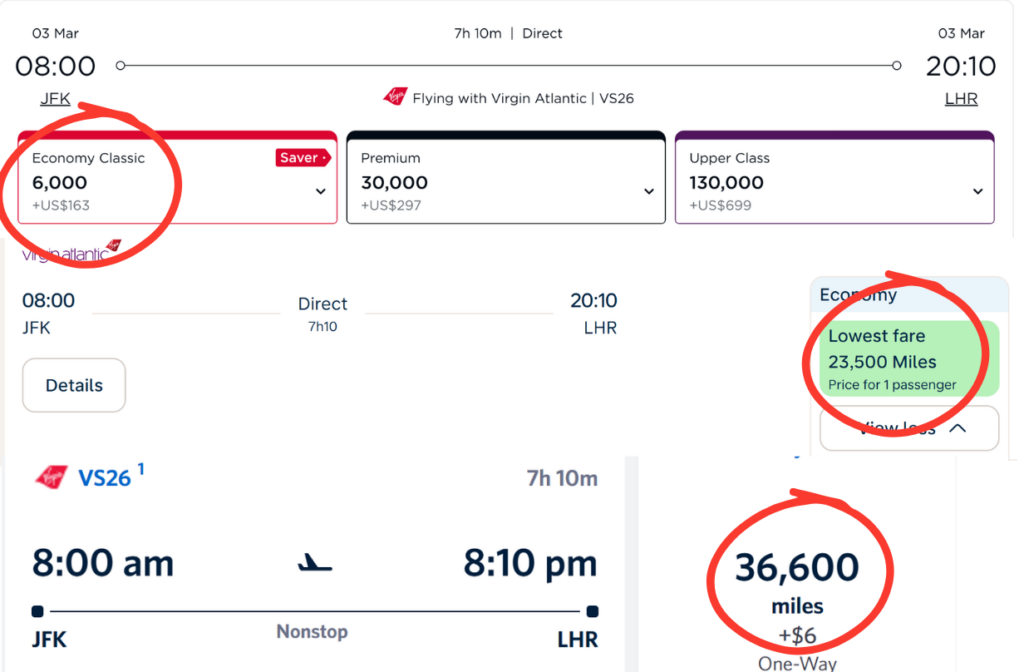
In this case, the Virgin redemption is the best value, grabbing almost 4 cents per point compared to Delta’s 1.1 cents and KLM’s 1.4. If you’ve spent all your time earning only Delta SkyMiles, you don’t have the best deal: in fact, you have the worst in this case, and you’d be better off paying all cash.
On a different day, however, this might shift. A Delta-operated flight might be best redeemed with SkyMiles. Or any number of other situations. Owning a general transferable card gives you the power to move points to the program that suits you best in any given moment. If you owned the Gold Card from American Express, for example, you could move points to any of those programs.
That’s why transferring is so powerful. It gives you maximum coverage in almost any situation compared to only owning a single loyalty currency. For this reason, I always advise keeping a primary store of general transferable points with Amex, Capital One, Chase, Bilt, or Citi — preferably a combination of them all — with individual airline points to supplement them, regardless of what your favorite airline is.
The Pitfalls
Transferring points is a terrific way to maximize value, but newcomers often get ahead of themselves after discovering their first high-value redemption.
Imagine a new points-and-miler has just redeemed the Virgin flight shown in the last section for 6,000 points. They’re smart enough to see that even though they’re paying $163 in fees, it’s giving them incredible value. But their excitement at that value has prompted them to do something else…
Transfer all their general transferable points to their Virgin account.
It makes sense, right? Virgin just scored incredible value, much better than Delta or KLM did, and so it stands to reason that moving all their points there would be a great idea.
But the next time they’re looking to travel, they’re on peak dates. They may even check the exact same JFK to London route and find an utterly eye-watering rate like the 150,000-point redemption below. Even with high cash rates, that flight is getting less than a cent per point.
That flight isn’t available on the other airlines, but using Flying Blue, they could fly on the same date in Premium Economy for just 40,000 miles instead.
But because they’ve already committed to Virgin, they don’t have a choice. They either cough up the 150,000 points for the Virgin flight or pay the cash rate. The amount of value lost there is immense.
They may use Virgin again. In fact, they may use it every time if the stars align. But overcommitting and moving points should be viewed as a cardinal sin in the points and miles world.

Even small-scale mistakes hurt
The example before is an extreme one, where one good interaction has spurred an overcommitment. But it happens on a micro-level, too, and is an even easier mistake to make.
If someone had a good experience with an airline in the past and trusts in their award rates, they may jump the gun on a redemption. If they’re looking for a flight to Paris from Los Angeles, and have managed to score two great redemptions with Flying Blue, they might casually throw 30,000 miles from their general card to their Flying Blue account. Work gets in the way, the family is busy that night, and by the time they get a chance to check the flight availability the next day, Flying Blue’s dynamic system has done its work, and the best redemption is 70,000 miles.
The best-case scenario is that they have plenty of miles left on their general card to transfer to somewhere useful this time and afford to wait for the 30,000 Flying Blue miles to become useful. In the worst-case scenario, they’ve just blown the last of their miles, will need to pay cash for this flight, and then hope they can use Flying Blue again in the future.
Regardless, every mistake in this game reduces value.
How To Counter It
The simplest answer is just to be proactive and aware. Protect your general points at all costs by only transferring them to an airline once you’ve checked the rates and the availability on the flight.
It’s important to consider how many seats are left on a flight before transferring, too. I’ve stumbled into that situation myself, when I attempted to book the only remaining award seat on an Air Canada redemption. The points transfer took longer than usual — this is always a slight risk — and by the time the points arrived in my account, the seat was gone.
As for the larger transfers, like the first example mentioned, I’d strongly advise you never to do this. I feel confident in plenty of airlines at the moment and know I can extract value in most cases. But systems are always shifting; demand and supply grow and shrink, and airlines regularly devalue their points on a whim. Just look at Flying Blue’s recent shifts to unbundled pricing. Overnight, its best award rates lost about 15-20% of their value.
The Point
Transferring early is tempting, especially if you’ve had a good experience with a specific airline. But overcommitting your general credit card’s points is risky and could see you lose hundreds, if not thousands, of dollars in value. Hold onto your miles until you’re sure you’ve found the best redemption, then don’t leave them sitting too long before you book.